High-throughput laboratories process hundreds, sometimes thousands, of samples daily. In fast-paced chromatography environments using High-Performance Liquid Chromatography (HPLC) and Gas Chromatography (GC), sample mix-ups, cross-contamination, and processing errors can lead to invalid analytical runs, costly downtime, and wasted reagents. While Laboratory Information Management Systems (LIMS) and barcode workflows handle digital tracking, visual identification remains the fastest human front-line line of defense. Implementing a clear, color-coded vial cap system provides immediate, intuitive visual sample management, reducing human error while streamlining lab operations.
Why Visual Sample Management Matters in High-Throughput Labs
In automated analytical workflows, human interaction occurs primarily during sample preparation, tray loading, and post-analysis disposal. During these touchpoints, relying solely on small textual labels or 1D/2D barcodes printed on 2 mL autosampler vials creates cognitive fatigue. Technicians must closely inspect tiny text or wait for a scanner response to verify sample identity or status.
Visual sample management leverages instant color recognition to categorize samples before they ever reach the instrument tray. By assigning distinct cap colors to specific sample types, preparation stages, priority levels, or hazardous materials, laboratories gain several key benefits:
- Error Reduction: Operators can spot misallocated samples, incorrect run orders, or missing control samples at a single glance across an entire 96-position autosampler tray.
- Workflow Efficiency: Technicians quickly sort and stage incoming samples without manually reading every small label, accelerating throughput during high-volume batch loading.
- Enhanced Safety: Color coding can immediately signal hazardous matrix types, toxic solvents, or light-sensitive compounds, ensuring personnel take appropriate handling precautions.
- Status Tracking: Assigning specific colors to key processing stages—such as raw matrix, prepped solution, or post-run archive—makes batch completion status obvious across shift handovers.
Common Cap Colors and Typical Lab Use Cases
Standardization is essential for effective color coding. While individual laboratories can tailor schemes to their specific application, adopting standard industry associations for cap colors makes onboarding intuitive for technicians.
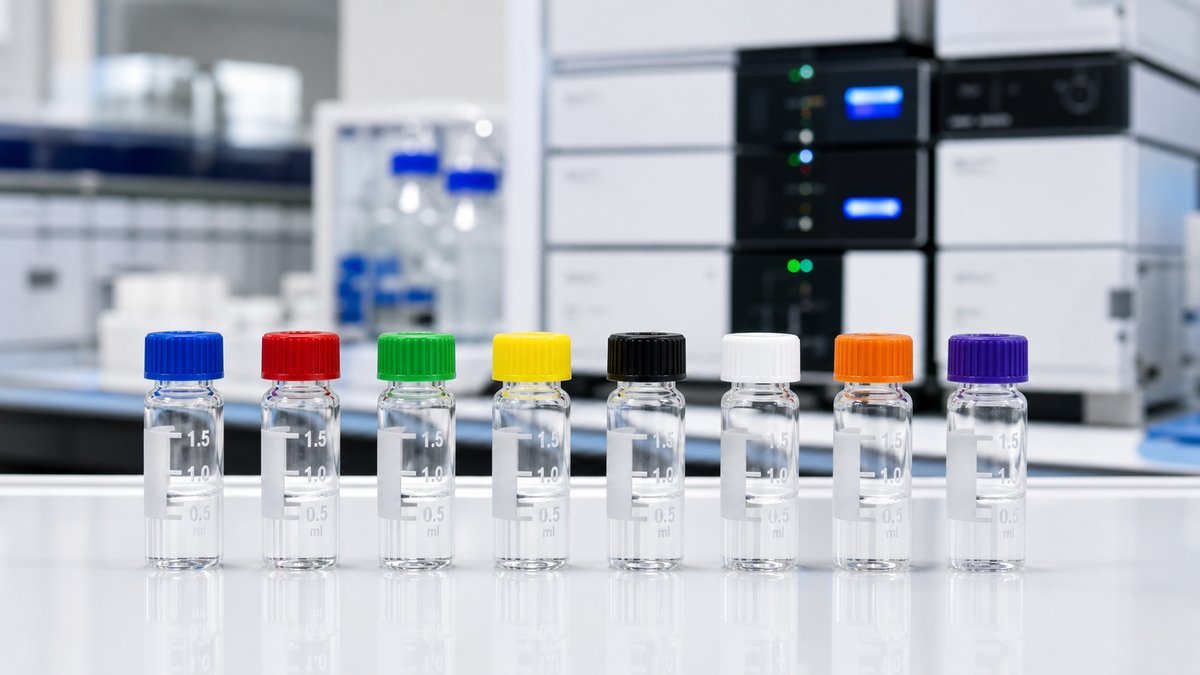
- Blue Caps: Widely used as the industry standard for routine, standard analytical runs, calibration standards, or quality control reference samples. Blue provides high visibility and neutrality.
- Red Caps: Frequently designated for urgent samples requiring immediate processing, high-priority re-tests, or known hazardous materials containing strong acids or reactive chemicals.
- Green Caps: Commonly assigned to environmental samples, blank matrices, or system suitability testing (SST) solutions that verify instrument readiness prior to running client samples.
- Yellow Caps: Ideal for light-sensitive compounds, stability testing batches, or samples undergoing specific incubation stages prior to injection.
- Black Caps: Often utilized for light-blocking autosampler vials containing photo-labile analytes, or reserved for blind quality assurance checks and double-blind controls.
- White Caps: Used for water blanks, wash solvents, mobile phase blanks, or pure solvent diluents intended to clear the column between analytical sequences.
- Orange Caps: Commonly designated for internal standards, surrogate spikes, or intermediate stock solutions used across multiple batch preps.
- Purple Caps: Frequently applied to specialized biological matrices, clinical serum/plasma samples, or research-grade compounds requiring non-standard extraction techniques.
How to Build a Lab-Specific Color Coding System
Designing an effective color-coding matrix requires balancing clarity with simplicity. Adding too many colors increases complexity and leads to confusion.
First, identify the primary operational bottleneck or risk point in your laboratory. If sample mix-ups occur during prep stages, base your color scheme on sample status. If cross-contamination or matrix interference is the main concern, base your system on sample type or solvent compatibility.
Second, limit your active color palette to five or six distinct colors per operational unit. Overusing subtle shade variations—such as light blue versus dark blue—causes ambiguity under varied laboratory lighting. Stick to high-contrast primary and secondary colors.
Third, document the color-coding rules in a clear Standard Operating Procedure (SOP). Visual wall posters posted above sample prep benches and instrument stations act as continuous reference guides for staff.
Fourth, ensure consistency across all shifts and departments. If red signifies “Rush Sample” in sample receiving, it must not signify “Reagent Blank” in the GC lab.
Material Considerations: Cap Color vs. Septa Properties and Compatibility
While cap color provides visual orientation, the physical performance of the vial closure depends on the underlying materials. A failure in chemical compatibility or physical septa integrity will compromise analytical results, regardless of how well organized the color system is.
Cap Body Materials and Threading
Autosampler cap bodies are typically molded from high-grade polypropylene (PP). Polypropylene offers good physical strength, dimensional consistency, and reasonable chemical resistance to common chromatography solvents like acetonitrile, methanol, and water. However, polypropylene caps are not suitable for prolonged contact with strong oxidizing acids (e.g., concentrated nitric, sulfuric, or chromic acid). For such applications, PTFE (polytetrafluoroethylene) caps must be used. Additionally, ensure that the color masterbatches used in PP caps are chemically inert and do not leach organic dyes into sample solutions or autosampler wash wells, especially when in contact with organic solvents.
Cap threads must match the corresponding vial thread standard to ensure a proper seal. Common thread standards include GPI 9-425 (for 9 mm vials), 8-425 (for 8 mm vials), 10-425 (for 10 mm vials), 13-425 (for 13 mm vials), 15-425 (for 15 mm vials), 18-400 (for 18 mm vials), and 24-400 (for 24 mm vials). Always verify thread compatibility between cap and vial to avoid leakage or autosampler jams.
Septa Color vs. Cap Color
Technicians must distinguish between the outer cap color used for sample management and the color of the inner septum face. Septa consist of two bonded layers: a soft elastomer layer (typically silicone or rubber) and a chemically inert barrier layer (typically PTFE).
The color of the septum face indicates its material formulation and physical properties, not the sample category:
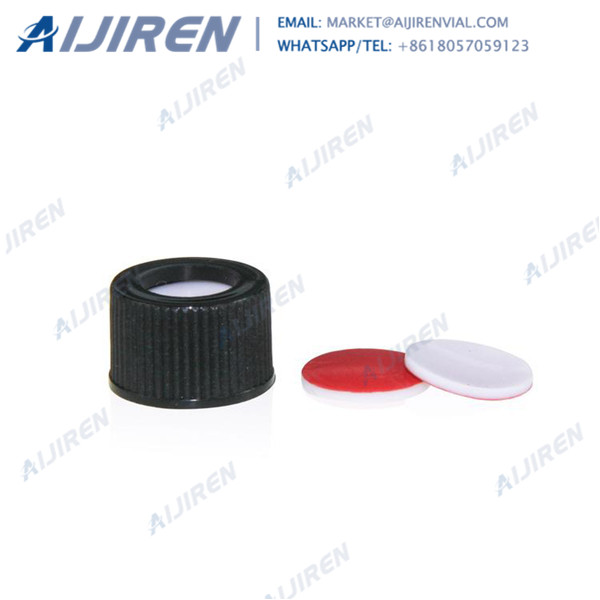
- Red PTFE / White Silicone (Universal Type): A standard for HPLC and GC applications, offering high chemical inertness and excellent resealing properties for multiple injections. The PTFE layer thickness is typically 0.5–1.0 mm; thicker PTFE provides better chemical resistance but may reduce needle penetration lifespan.
- Blue PTFE / White Silicone (Pre-cleaned): Provides similar inertness with enhanced visual contrast for automated needle-alignment vision systems in modern autosamplers. This type is often pre-washed and certified for LC-MS/MS applications to minimize background contamination.
- White PTFE / Red Rubber (Single-injection, Low-cost): A cost-effective option for single-injection routine analysis, though less suitable for long-term sample storage due to lower thermal and chemical stability of the rubber layer.
- PTFE-Free Septa (Polyethylene or Polypropylene): Used in high-sensitivity mass spectrometry (LC-MS/MS or GC-MS) where siloxane leachates from silicone septa must be completely eliminated. These septa are typically color-coded differently (e.g., natural or white) to indicate the absence of PTFE.
Always verify that changing cap colors does not alter the underlying septum specifications required for your instrument needle geometry or solvent composition.
Integration with LIMS and Barcode Systems
A visual color-coded system does not replace digital sample tracking; it complements it. Integrating cap colors with LIMS and 1D/2D vial barcoding creates a multi-layered sample verification system.
Modern LIMS platforms allow administrators to map cap color attributes directly to sample meta-data fields during sample login. When a batch worklist is printed or displayed on an instrument controller, the system displays both the barcode number and the expected cap color icon.
During automated tray loading, operators scan the vial barcode using a handheld scanner or the autosampler’s internal barcode reader. The technician uses visual color matching to verify that the physical vial placed in position 12 matches the green cap indicator on the software screen. This dual-verification approach catches human misplacement errors before the analytical run begins, avoiding wasted run time and costly column re-equilibration.
Practical Tips for Implementation
Transitioning a busy laboratory to a color-coded sample management workflow requires careful execution to avoid disruption.
- Conduct a Consumable Audit: Review current inventory to determine existing cap usage. Consolidate vendor orders to ensure color consistency across lots.
- Start with a Pilot Phase: Test the new color coding scheme on one high-volume instrument line or prep workstation before rolling it out lab-wide. Gather feedback from technicians to refine the scheme.
- Implement Color-Coded Storage: Align sample storage racks, freezer boxes, and transport trays with the same color scheme used for vial caps to maintain visual continuity from receiving to disposal.
- Keep Color Reference Charts Visible: Post clear, laminated visual guides directly on autosampler modules and prep workstations.
- Regularly Review Compliance: Periodically audit autosampler trays to verify that cap colors match the logged sample types and SOP requirements.
By combining the structural discipline of LIMS and barcoding with the intuitive speed of color identification, laboratories establish a robust, error-resistant framework for modern sample management.