The auditor set a clear glass vial on the bench, 2 mL, 12 x 32 mm, and pointed at the septum. “Show me the lot number on that,” she said. We could not. We could show her the case carton and the purchase order, but the individual septum had no batch code, and the receiving log recorded only “septa, 11 mm, qty 1000.” That single gap turned a routine EPA method audit into a two-day paper chase, and it is the first thing I fix at any lab I walk into now. If you handle samples under SW-846 or a method incorporated by reference from it, the septum on your HPLC vial is a documented part of the sample container, and EPA method requirements for septa are enforced through the paperwork that proves which lot touched which sample. This article is about what those methods actually say, and what the auditor asks for before anything else comes out of the filing cabinet.
SW-846 is the EPA’s Test Methods for Evaluating Solid Waste, and it is a living compendium rather than a single regulation. You can read the current structure at the EPA SW-846 page. What matters for a procurement or lab manager is that the methods talk about sample containers and holding times in general terms. Method 5030 (purge and trap), Method 8260 (VOCs by GC-MS), and the 8000-series organics methods all assume a container that does not leak and does not contaminate the sample. None of them specify a septum durometer, a PTFE facing thickness, or a puncture limit.
That silence is the trap. Because the method does not define the septum, the auditor falls back on two things: the laboratory’s own written procedure, and the general requirement in SW-846 Chapter One that sample containers be appropriate to the analyte and documented. If your SOP says “11 mm septa, PTFE-lined, silicone” and the receiving log cannot tie a case to a lot, you have a gap between what you wrote and what you can prove. Auditors live in that gap.
I have sat through enough of these to know the sequence. The auditor does not start with the septum. She starts with the sample receipt log, then walks backward to the container, then asks for the certificate of analysis or the specification sheet for the closure. The septum is where the trail usually goes cold, because septa are the one consumable most labs buy by the thousand and track by nobody.
What the method text actually obliges you to control
Strip away the method-specific detail and SW-846 imposes four obligations on the sample container that a septum directly affects. Each one has a paper trail an auditor can request.
Container integrity and the leak test
Volatile methods assume a headspace-free, sealed container. Method 5030 and the 8260 family expect the vial to hold its contents from collection to analysis within the holding time, which for VOCs is typically 14 days with zero headspace. A septum that has been punctured and re-sealed, or one that cores on the first injection, breaks that assumption silently. The auditor’s question is not “did it leak?” but “how would you know if it had?” If your answer is a visual check at receipt, that is thin. The defensible answer is a documented septum specification (thickness, durometer, facing material) plus a receiving inspection that includes a dimensional check and, at minimum, a lot-level leak or coring check on a sample of the shipment.
Analyte compatibility and the PTFE facing
The septum is in contact with the sample vapor, and for VOC work the facing material matters. A plain silicone septum will absorb and later release hydrophobic analytes. That is why the standard construction is a silicone body with a PTFE facing on the sample side, typically 0.010 in (0.25 mm) thick. The auditor may ask you to demonstrate that the facing is present and oriented correctly, because a septum installed facing-out is functionally a different container. Your SOP should state the facing orientation, and your receiving inspection should confirm it on a cut sample.
Holding time and the puncture budget
Holding times assume the container is not re-opened. Every puncture of the septum is a small violation of that assumption, and a septum has a finite puncture life before it cores or leaks. For a standard 11 mm silicone/PTFE septum on a 20 mm crimp or screw cap, I treat one to two autosampler punctures as the practical working limit for a vial that will be re-injected, and I do not reuse a septum across a multi-injection sequence. If your method involves re-injection from the same vial, your SOP needs to state the puncture limit and your log needs to show you did not exceed it. This is where the vial septa specification and the injection count on the sequence table have to agree.
Contamination control and the blank
Method blanks are where septum problems surface as data. A plasticizer or a silicone oil bleeding from a low-grade septum will show up in the blank at low levels, and an auditor who sees a rising baseline across a batch will ask what changed. The defensible position is a septum with a documented extractables profile and a lot that has been checked against a blank. I keep a lot-specific blank run for any new case of septa before it goes into production, and I file it with the receiving record.
The paperwork an auditor asks for first, in order
This is the part most labs get wrong, and it is the part this article exists to fix. When an auditor opens the container-control section, the requests come in a predictable order. Have these ready and the septum conversation takes ten minutes instead of two days.
- The sample receipt log, showing container type, lot or case identifier, and receipt date for each batch.
- The septum specification sheet from the vendor, with dimensions (11 mm or 13 mm, thickness, durometer), facing material and thickness, and temperature rating.
- The certificate of analysis or conformance for the specific lot in use, not a generic datasheet.
- The receiving inspection record, showing what you checked and the result: dimensional, facing orientation, and any lot-level leak or coring check.
- The SOP that states facing orientation, puncture limit, and the rule for when a septum is retired.
- The method blank or system suitability data that demonstrates the lot did not introduce contamination.
If any of those six is missing, the auditor has a finding. The most common missing item is number three, the lot-specific certificate, because labs buy septa in bulk cases that carry a single certificate for the case and then split the case across months. The fix is to record the case lot on the receiving log and to keep the certificate filed against that lot, not against the purchase order. When you buy through a distributor, confirm the lot on the certificate matches the lot on the carton before you sign for it. This is the same discipline you already apply to columns and standards; see how a serious vendor documents it at Agilent’s GC columns and accessories and Thermo Fisher’s chromatography and sample handling pages, where lot traceability is part of the product record.
Where the method expectations and the physical septum collide
The method assumes a sealed, inert, single-use container. The physical septum is a punched elastomer with a finite life. The auditor’s job is to find where your practice has quietly departed from the assumption. Three failure modes account for most of the findings I have seen.
Coring that shows up as a lost analyte, not a visible hole
A cored septum drops a plug of silicone into the vial. The plug does not always block the needle; often it sits in the sample and adsorbs hydrophobic analytes, so the result is a low recovery on a specific compound rather than an instrument fault. The auditor sees a recovery outside the acceptance window and asks what changed. If your receiving inspection never checked coring, you cannot answer. A simple lot check: puncture a sample of ten septa with the actual autosampler needle at the actual injection depth and inspect the facing for plugs. If you see plugs on more than one of ten, the lot is suspect. I have rejected cases on that check alone.
Facing orientation reversed at installation
This is a training failure, not a product failure, but it produces a real method deviation. A septum installed with the PTFE facing away from the sample exposes the silicone body to the vapor. The result is elevated blank levels and, over a batch, a drift in the internal standard response. The auditor’s tell is a blank that looks fine at the start of the batch and degrades by the end. The fix is a visual orientation check in the SOP and a receiving inspection that confirms facing on a cut sample. On a 20 mm crimp cap, the facing goes toward the sample, full stop.
Reuse across a sequence
Reusing a septum across a multi-injection sequence is the single most common departure from the method’s sealed-container assumption, and it is the one auditors probe hardest because it is invisible in the data until it is not. A septum rated for one or two punctures, used for ten injections, will leak at the puncture site and admit air. The tell is a rising oxygen or nitrogen peak on a GC or a drifting retention time. The fix is a written puncture limit and a sequence table that counts injections per vial. If the method requires re-injection, use a fresh septum and a fresh vial for the re-injection, or state in the SOP why the reuse is acceptable and back it with data.
Field case one: the 14-day holding time that was not held
A contract lab running Method 8260 had a batch of samples fail the holding-time check at the auditor’s desk. The receipt log showed collection dates, but the analysis dates on the sequence table were three days past the 14-day window for a subset of vials. The samples had been re-injected because the first run failed system suitability. The lab had reused the septa across the re-injection, and the second run showed low recoveries on the light ends. The measurement that identified it was the injection count per vial: the sequence table showed four punctures on a septum the SOP said was good for two. The fix was a puncture count column on the sequence table and a rule that a re-injection gets a fresh autosampler vial and septum. The holding-time finding went away because the re-injection no longer produced a failed run that pushed the analysis past the window. The auditor’s follow-up was the receiving log, which by then carried the case lot and the certificate. That is the whole chain: puncture count, holding time, lot record.
Field case two: the blank that drifted across the batch
A different lab, running a volatile method on a GC-MS, had a method blank that started clean and showed a siloxane peak by the tenth injection. The auditor flagged it as a possible septum bleed. The measurement that identified it was a facing-orientation check on a cut septum from the case in use: the PTFE facing was on the cap side, not the sample side, on the entire case. The vendor had packed the septa facing-down in the carton, and the tech had installed them as packed. The fix was a one-line change to the receiving inspection (cut one septum per case, confirm facing toward the sample) and a note in the SOP. The blank came back clean on the next case. The lesson is that the septum can be the right part number and still be installed wrong, and the only way to catch it is a physical check at receiving.
A receiving checklist with numbers you can defend
This is the checklist I hand to a lab that is about to be audited. It is short on purpose. Every line is something an auditor can ask you to produce.
| Check | Target or limit | Record |
|---|---|---|
| Nominal diameter | 11 mm or 13 mm, matching cap | Calipers, sample of 10 |
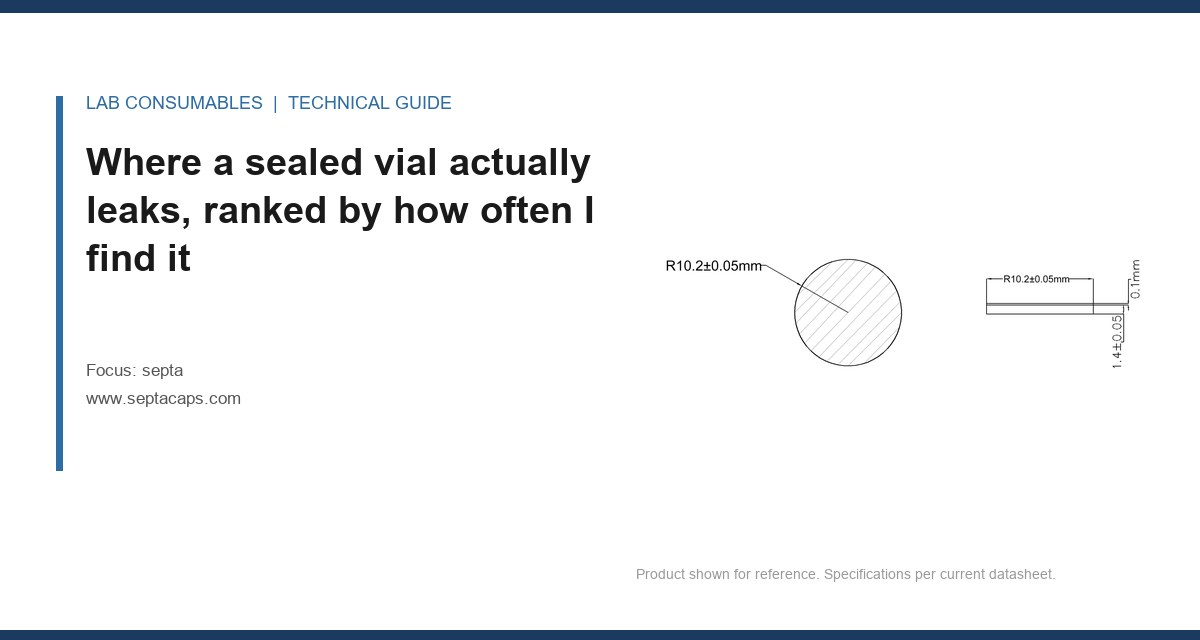
| Thickness | 0.040 to 0.060 in (1.0 to 1.5 mm) typical for 11 mm | Calipers, sample of 10 |
| PTFE facing thickness | 0.010 in (0.25 mm) nominal | Cut sample, visual |
| Facing orientation | Toward sample on installation | Cut sample, visual; SOP line |
| Coring check | No plugs on more than 1 of 10 punctures | Puncture test with production needle |
| Temperature rating | At or above method’s maximum (e.g., 200 °C for GC inlet) | Vendor spec sheet |
| Lot on certificate | Matches lot on carton | Certificate filed against lot |
| Blank check | No analyte above method reporting limit | Lot blank run filed with receipt |
Two notes on the numbers. The thickness range is a working band, not a regulation; a septum too thin will leak at the crimp, and one too thick will not seat. The temperature rating is the one that catches people on GC inlets, where the septum sees the inlet temperature, not the oven temperature. If your inlet runs at 250 °C and your septum is rated to 200 °C, you have a bleed source the auditor will find in the blank. For a deeper look at how a serious supplier documents these specs, the technical resources at Restek are a reasonable reference point, and the septa product line at septacaps.com is where I point labs that need lot-level documentation on the closure itself.
The decision rule: buy the lot record, not the part number
If you take one thing from this, take the buying rule. The EPA method does not tell you which septum to buy. It tells you the container must be sealed, inert, and documented, and the auditor enforces that through the record. So buy the record. Specify a septum with a PTFE facing, a stated thickness and durometer, a temperature rating above your inlet maximum, and a lot-specific certificate of conformance. Require the lot number on the carton to match the certificate, and file the certificate against the lot on your receiving log. Write the facing orientation and the puncture limit into the SOP, and check both at receiving with a cut sample and a puncture test. Do that, and the septum stops being the weak link in the audit. It becomes one of the few consumables you can prove you controlled.
References & further reading
Related resources from our lab consumables network:
- Septa at septacaps.com
- Vial Septa at vialsepta.com
- Hplc Vial at hplcgc.com
- Autosampler Vial at autosamplerhplc.com
External references and standards: