Why Septum Material Choice Directly Determines Long-Term Sample Integrity
When chromatography samples must be stored for days, weeks, or months before analysis, the choice of vial closure becomes a critical determinant of data quality. While laboratories routinely debate vial glass type and storage temperature, the septum material is often selected on autopilot — yet it is the septum that forms the primary barrier between the sample and the external environment. Two fundamentally different elastomer families dominate the market: butyl rubber and PTFE/silicone composites. Each offers a distinct profile of permeability, chemical resistance, and extractables risk that makes it suited to specific storage applications.
This article compares butyl rubber and PTFE/silicone septa across the dimensions most relevant to long-term sample storage: gas barrier performance, solvent vapor transmission, extractables and leachables profiles, resealing capability, and practical handling considerations.
Material Composition and Barrier Fundamentals
Butyl rubber is a copolymer of isobutylene with a small fraction of isoprene, typically 1 to 2 percent. The dense packing of the polyisobutylene backbone — with its two methyl groups per monomer unit — creates an exceptionally low free volume within the polymer matrix. This molecular architecture gives butyl rubber the lowest gas permeability of any commercially available elastomer, approximately 10 to 20 times lower than natural rubber and significantly lower than silicone for gases such as oxygen, nitrogen, and carbon dioxide.
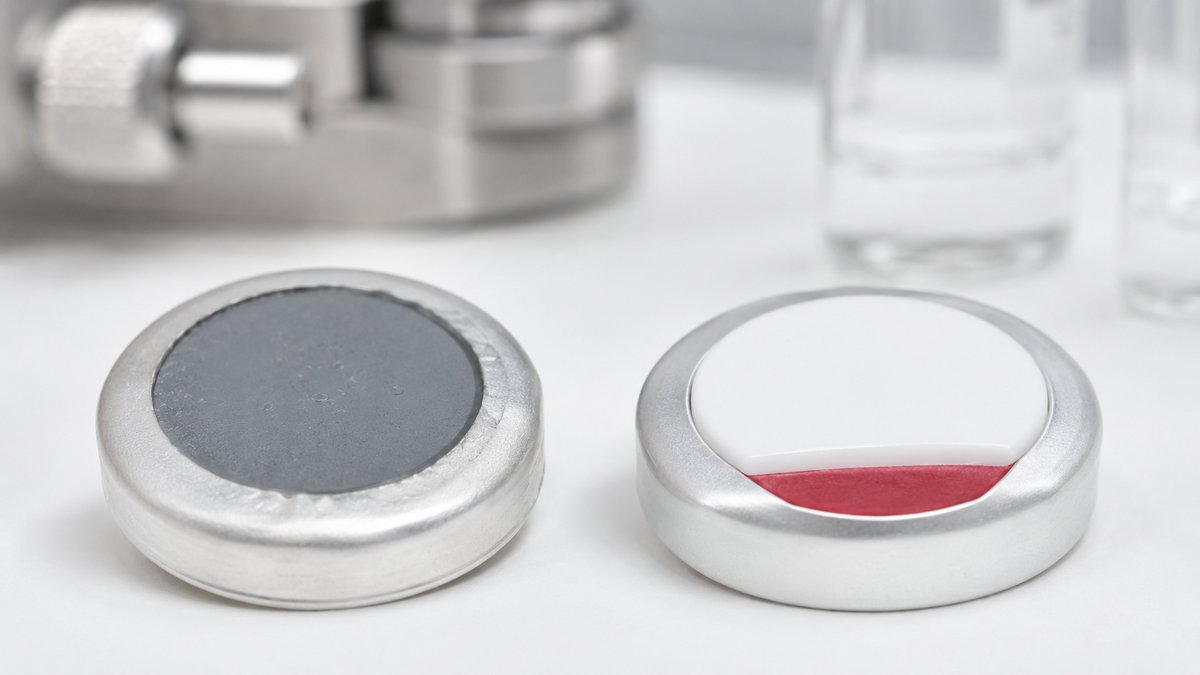
PTFE/silicone septa employ a fundamentally different approach. The PTFE (polytetrafluoroethylene) facing layer, typically 0.25 to 0.50 mm thick, provides an almost universally chemically resistant barrier against liquid-phase contact. The silicone backing layer supplies the necessary elasticity for needle puncture and resealing. Unlike butyl rubber’s bulk barrier mechanism, the PTFE/silicone composite relies on the PTFE film as a thin but highly effective chemical shield. This layered construction means that overall barrier performance depends critically on the integrity, thickness, and bonding quality of the PTFE layer.
Gas Barrier Performance: The Critical Variable for Long-Term Storage
For samples sensitive to oxidation or atmospheric contamination, oxygen transmission rate (OTR) is the single most important septum property. Butyl rubber septa exhibit an OTR of approximately 50 to 100 cc-mil/m2-day-atm, compared to 50,000 to 80,000 for unfaced silicone rubber. The PTFE facing layer on composite septa provides some improvement over bare silicone, but PTFE itself is not an exceptional gas barrier — its oxygen permeability is roughly 200 to 400 cc-mil/m2-day-atm, still substantially higher than butyl rubber.
The practical consequence is clear: for oxygen-sensitive analytes, headspace GC samples, or any application where dissolved atmospheric gases would degrade the sample, butyl rubber septa provide unequivocally superior protection. A sample stored under a butyl rubber closure will experience oxygen ingress at a rate roughly two orders of magnitude slower than one stored under a PTFE/silicone septum.
Moisture vapor transmission follows a similar pattern. Butyl rubber’s moisture vapor transmission rate (MVTR) of 0.5 to 1.5 g-mil/100in2-day is approximately 10 to 20 times lower than unfaced silicone. For hygroscopic samples or those in water-miscible solvents where solvent evaporation would cause concentration changes, butyl rubber closures help maintain compositional stability over extended storage periods.
Chemical Resistance and Extractables Profiles
While butyl rubber excels as a gas barrier, its chemical resistance spectrum is narrower than PTFE. Butyl rubber offers good resistance to water, alcohols, glycols, and many polar organic compounds. However, it is susceptible to swelling and degradation upon prolonged contact with non-polar solvents such as hexane, toluene, and chlorinated solvents. In these environments, butyl rubber can release oligomeric fragments, processing aids, and antioxidant additives into the sample — a particularly concerning pathway for trace-level analysis.
The extractables profile of butyl rubber typically includes low-molecular-weight polyisobutylene fragments, hindered phenol antioxidants (such as BHT), fatty acid derivatives from stearate processing aids, and residual zinc oxide or carbon black fillers. For GC-MS and LC-MS methods operating at trace detection limits, these extractables can produce significant interference peaks. Comprehensive extractables studies performed by reputable septum manufacturers typically identify 20 to 40 individual extractable compounds from standard-grade butyl rubber formulations.
PTFE/silicone septa present a markedly different extractables landscape. The PTFE facing layer, when manufactured to pharmaceutical-grade specifications, contributes essentially zero organic extractables under normal storage conditions. The silicone backing layer can release cyclic siloxane oligomers (D3 through D8), but these are largely prevented from reaching the sample by the intervening PTFE barrier — provided the PTFE layer remains intact and well-bonded. Total extractables from high-quality bonded PTFE/silicone septa are typically 5 to 10 times lower than from butyl rubber equivalents.
For trace-level organic analysis, aggressive organic solvents, and applications requiring the lowest possible extractables background, PTFE/silicone septa with verified low-extractables certification are the preferred choice — despite their inferior gas barrier performance.
Resealing Capability and Multiple Puncture Performance
Long-term storage applications often require the ability to sample from the same vial multiple times over the storage period. This demands reliable resealing after each needle puncture — an area where material properties diverge significantly.
Butyl rubber exhibits moderate resealing capability. Its higher hardness (typically Shore A 55 to 70) compared to silicone (Shore A 40 to 55) means that the puncture hole closes more slowly and less completely after needle withdrawal. After 3 to 5 punctures, butyl rubber septa may begin to exhibit measurable leakage. For single-use or limited-puncture storage protocols, this is rarely problematic. For protocols requiring frequent sampling from the same vial, butyl rubber’s resealing limitations should be considered.
PTFE/silicone septa offer superior resealing performance, driven by the elastic recovery of the silicone core. The PTFE facing layer, while not inherently elastic, is thin enough to conform to the resealing action of the underlying silicone. Premium silicone formulations can withstand 8 to 12 punctures before seal integrity begins to degrade, making PTFE/silicone septa the better choice for multi-sampling storage protocols. Pre-slit PTFE/silicone septa further extend puncture life by reducing the mechanical energy required for needle penetration.
Decision Framework: Matching Septum Material to Storage Requirements
Selecting between butyl rubber and PTFE/silicone septa for long-term storage should follow a systematic evaluation of the sample’s specific vulnerabilities:
- Oxygen-sensitive or volatile samples: Butyl rubber is the clear first choice. Its superior gas barrier properties minimize oxidation and evaporative loss. This includes headspace GC samples, dissolved gas analysis, volatile organic compound (VOC) storage, and oxygen-labile pharmaceutical compounds
- Samples in aggressive organic solvents: PTFE/silicone septa are strongly recommended. The PTFE facing layer provides near-universal chemical resistance that butyl rubber cannot match. This applies particularly to chlorinated solvents, aromatic hydrocarbons, ketones, and esters
- Trace-level analysis with strict extractables limits: PTFE/silicone septa with documented low-extractables certification. The extractables burden from butyl rubber formulations can compromise detection limits in LC-MS/MS and GC-MS/MS methods operating below 1 ppb
- Multi-sampling protocols: PTFE/silicone septa, preferably pre-slit, offer superior resealing and longer functional life under repeated puncture conditions
- Aqueous samples and polar solvents: Both materials perform adequately, and the decision may be driven by secondary factors such as cost, availability, and compatibility with existing cap crimping or capping equipment
For the most demanding applications — where both ultra-low gas permeability and minimal extractables are required — some manufacturers offer butyl/PTFE laminated septa. These combine a butyl rubber core for gas barrier performance with a thin PTFE facing layer for chemical resistance and reduced extractables. This hybrid construction represents the optimal material solution for long-term storage of sensitive samples, though at a higher unit cost than either standard butyl or PTFE/silicone alternatives.
Storage Validation: Confirming Septum Performance in Your Application
Material datasheets provide useful starting points, but septum performance should ultimately be validated under your specific storage conditions. A simple protocol involves preparing replicate vials of a representative sample, sealing them with candidate septum materials, and analyzing them at predetermined time intervals. Monitor for concentration changes (indicating evaporative loss), appearance of new peaks (indicating extractables or oxidation products), and pH shifts (indicating carbon dioxide ingress in unbuffered aqueous samples).
Storage at elevated temperature — such as 40 C rather than 4 C — can accelerate degradation processes and provide early warning of compatibility issues. If your stability protocol includes freeze-thaw cycles, verify that the selected septum material maintains its sealing integrity through the thermal expansion and contraction of the vial contents. Butyl rubber’s lower-temperature flexibility limit (typically -30 C to -40 C) is adequate for most freezer storage applications, while silicone retains elasticity to approximately -60 C.
Related Resources from hplcvials.com:
- Product: 8-425 Small Opening Caps and Silicone Septa with Customizable Lab Seals for Vial
- Guide: What is the difference between PTFE and silicone s…
- Guide: The Growing Demand for Personalized Chromatography…
- Guide: Sealing Performance of PTFE/Silicone Septa under H…
The septum is not merely a cap liner — it is an active participant in the storage environment that influences sample composition through its permeability, its extractables, and its mechanical integrity over time. Informed material selection, grounded in an understanding of these mechanisms, is the difference between a stability study that generates reliable data and one that generates confounding artifacts.