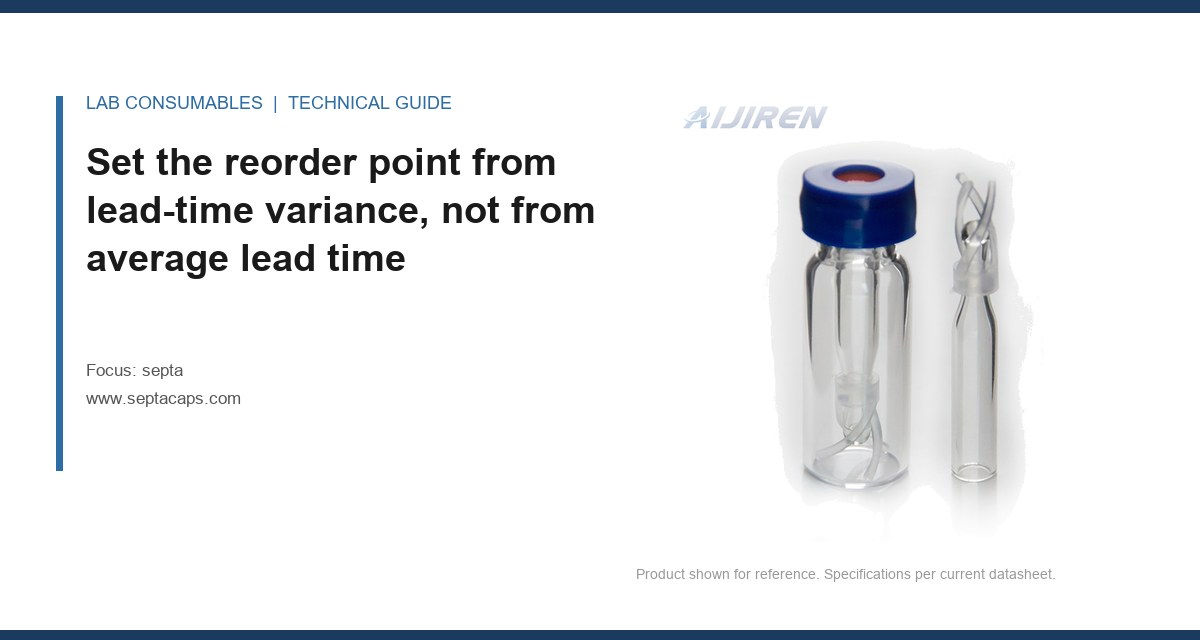
Last March a 48-position autosampler rack ran dry at 4:12 a.m. because the buyer had set the septa reorder point at “one case” and nobody noticed the case was three weeks late. The line had been consuming 340 septa a week, the distributor’s quoted lead time was 10 working days, and the actual delivery on the previous four POs had averaged 19 days. That gap between quoted and actual is the whole reason septa MOQ, lead time, and reorder point planning deserves its own spreadsheet rather than a line in a generic consumables budget. The rack held 48 vials, the method ran 22 minutes a vial, and the failure cost nine hours of instrument time plus a re-injection of 48 samples. I have run that cost calculation enough times to know the spreadsheet is cheaper.
I have bought and sold septa for long enough to be blunt: most labs treat septa like paper clips until a run fails, then over-order in a panic and sit on 18 months of inventory that goes brittle in the stockroom. The fix is arithmetic, not intuition. Below is the arithmetic I actually use, including the parts most procurement templates skip.
The textbook reorder point is average daily consumption times average lead time, plus safety stock. That formula is fine for toner cartridges. For septa it fails because lead time is the variable that moves, and it moves in one direction: longer. A distributor that quotes 10 days and delivers in 19 has an average lead time of maybe 14 days and a standard deviation of 5. If you plan to the average, you will stock out roughly half the time.
The working formula I use:
ROP = (average daily consumption × average lead time) + (Z × daily consumption × lead-time standard deviation)
Where Z is your service-level factor: 1.65 for 95%, 2.33 for 99%. For a 340-per-week line, that is about 48.6 septa a day. With a 14-day average lead time and a 5-day standard deviation at 99% service:
- Cycle stock: 48.6 × 14 = 680 septa
- Safety stock: 2.33 × 48.6 × 5 = 566 septa
- Reorder point: 1,246 septa
That is roughly 2.5 cases of 500, not one case. The one-case policy was under-stocked by a factor of two and a half, and the 4 a.m. dry rack was the predictable result. If you do not have lead-time history, pull the last four PO receipt dates from your ERP and calculate the standard deviation yourself. Four data points is thin, but it beats a guess.
Run the same math at 95% service and the reorder point drops to 680 + (1.65 × 48.6 × 5) = 1,081 septa. That difference of about 165 pieces, or a third of a case, is the price of the higher service level. For a line feeding a validated method, I pay it. For a line running screening work where a stockout costs a re-injection rather than a regulatory deviation, 95% is fine. The point is to choose the service level deliberately, not to inherit it from whatever the ERP defaulted to when the part number was created.
How to collect lead-time data without a procurement analyst
Log three dates per PO: order placed, order acknowledged, and goods received. The acknowledged date is the one that matters, because it is the date the vendor committed to after seeing their own stock. A vendor who acknowledges in two days and ships in three is a stock-holding distributor. A vendor who acknowledges in nine days is drop-shipping from a factory, and their 10-day quote is really a 20-day reality. Track the gap between quoted and acknowledged lead time for six months and you will know which type you are dealing with.
I keep a simple column in the purchasing sheet: quoted LT, acknowledged LT, actual LT. The variance between quoted and actual is the number I negotiate against at renewal, not the price. When a distributor’s actual lead time has drifted from 12 to 19 days over two quarters, that is the conversation, and it usually gets a stock commitment or a better acknowledgment SLA rather than a discount that does nothing for the person waiting on the rack.
One more data point worth logging: the receipt condition. A case that arrives with a broken seal, a crushed corner, or a lot number that does not match the packing slip is a lead-time problem in disguise, because you will spend a week resolving it before you can use the stock. I add a fourth column, receipt exceptions, and any vendor with more than two in a year goes on the watch list. Over three years I have seen roughly one in twelve septa shipments arrive with some exception, most often a lot mismatch on a partial fill.
What an MOQ actually costs you in carrying cost
Septa MOQs are usually quoted in cases of 500 or 1,000, sometimes with a lower MOQ at a higher unit price. The instinct is to take the lowest unit price. Do the carrying-cost math first.
Carrying cost for lab consumables runs 20 to 30% of inventory value per year. That covers storage, insurance, obsolescence, and the cost of money. For septa specifically, add a hard expiry risk: silicone and silicone/PTFE septa have a shelf life, and a septa that has sat in a hot stockroom for two years will show higher bleed and worse reseal performance than a fresh one. I have seen bleed baseline rise by 30 to 40% on a two-year-old lot compared with a fresh lot from the same manufacturer.
Here is the comparison that actually decides the MOQ question for a line consuming 340 a week:
| Option | MOQ | Unit price index | Weeks of cover | Annual carrying cost (relative) |
|---|---|---|---|---|
| A: lowest unit price | 5,000 | 100 | 14.7 | High (14+ weeks stock, expiry risk) |
| B: mid MOQ | 2,000 | 108 | 5.9 | Moderate |
| C: low MOQ, higher price | 500 | 122 | 1.5 | Low, but reorder admin cost rises |
Option A looks cheapest per unit but ties up 14 weeks of stock and pushes you into the expiry window. Option C minimises carrying cost but drives four to five POs a month, each with its own admin and freight burden. Option B is usually the sweet spot: enough cover to ride a lead-time spike, short enough that the oldest stock is under six weeks old.
The break-even calculation for a higher MOQ
Take the annual quantity (340 × 52 = 17,680), divide by the MOQ, and that is your order frequency. Multiply by the admin cost per PO (I use $75 to $120 for a lab buyer’s time plus receiving). Then compare against the annual carrying cost of the extra stock the larger MOQ forces you to hold. If the unit-price saving on the larger MOQ does not beat the sum of those two, take the smaller MOQ. In my experience the larger MOQ almost never wins once carrying cost and expiry risk are in the calculation for a mid-volume line.
Worked example with real numbers. Option A at 5,000 pieces means 3.5 POs a year, say 4, so $480 in admin. The annual stock value at, say, $0.35 a piece is 17,680 × 0.35 = $6,188, and the average on-hand is half the order, so about $3,094 of average inventory, at 25% carrying cost = $774 a year. Option B at 2,000 pieces means 9 POs a year, $1,080 in admin, but the average on-hand is about $1,238, carrying cost $310. The admin penalty of Option B is $600 a year; the carrying-cost saving is $464. Add the expiry write-off risk on Option A, which at even a 5% write-off rate is $309 a year, and the two options are within noise of each other on cost, but Option B wins decisively on expiry risk and on the ability to switch suppliers mid-year. That is the calculation that changes the decision, not the unit price.
The reorder point should be a physical location, not a number in an ERP
Here is the failure mode I see most often: the reorder point is correct on paper but nobody triggers it, because the ERP only fires when someone remembers to check it, and the person who remembers is on holiday. The fix is to make the reorder point a physical thing. Put a labelled divider in the stockroom at the reorder-point quantity (in our case, at the 1,246-septa mark, so roughly the start of the third case). When the picker breaks that divider, they scan a card and the buyer gets a notification. The number on the card is the ERP number, but the trigger is physical and cannot be forgotten.
This is boring and it works. The labs that never run dry are the ones where the reorder point lives on a shelf, not in a report. I have set this up in four different stockrooms and the pattern is identical: the first month the divider gets broken twice as often as the ERP predicted, because the ERP number was based on stale consumption, and by month three the two agree. That reconciliation is itself useful information.
Lead time is not one number, and the split matters
When a distributor quotes “10 days”, ask what is inside it. My own breakdown for septa typically looks like this:
- Order acknowledgement and stock check: 1 to 3 days
- Pick, pack, and dispatch from distributor: 1 to 2 days
- In-transit freight: 2 to 5 days (longer for cross-border, customs adds 2 to 7)
- Receiving and QC hold at your site: 1 to 3 days
Only the first two are under the distributor’s control. If the acknowledgement step is taking nine days, they do not hold stock, and the rest of the quote is fiction. I ask one question at renewal: “How many cases of this part number are on your shelf right now?” A stock-holding distributor answers in seconds. A drop-shipper deflects. That single answer predicts your lead-time variance better than any SLA clause.
I also ask how they pack. Septa ship in bags or trays inside a case, and a distributor who ships a case of 500 loose in a carton with no inner packing will hand you a lot with crushed septa at the bottom. Crushed septa fail the fit trial and, worse, can shed particulates into the vial. Ask for the inner pack specification and reject any shipment where the bags are open or the trays are shifted.
When to hold a second approved source
For any septa line consuming more than 200 a week, I keep a second approved source qualified, even if I do not buy from them regularly. Qualifying means a fit trial and a short performance run, not just a price quote. The second source is your hedge against a single distributor’s stockout, and it is worth the small extra admin to keep it live. Rotate a small order (one case) to the second source every six months so the relationship and the qualification stay current.
The one thing I never do is qualify the second source at the last minute, mid-stockout. A fit trial takes a week of instrument time and a performance run takes another, and neither is available when the rack is dry. The second source has to be live before you need it.
Two field cases where the planning numbers told the story
Case 1: the phantom stockout
Symptom: a GC lab on a 96-vial autosampler ran out of septa twice in one quarter despite a reorder point that looked generous. Measurement: the ERP reorder point was set on issued quantity, but the pickers were pulling from a second, unlogged stockroom shelf. Actual consumption was 40% higher than the ERP believed: 340 a week on paper, 476 a week in reality. The reorder point was correct for the wrong number. Fix: consolidate to one shelf, reconcile physical count to ERP weekly for a month, then re-set the reorder point using the true consumption rate. The reorder point moved from 1,246 to 1,744 pieces, and the stockouts stopped.
Case 2: the MOQ that aged out
Symptom: an HPLC lab reported rising baseline noise and a new shoulder peak on early-eluting compounds. Measurement: the septa in use were from a lot 22 months old, bought under a 5,000-piece MOQ to get the best unit price. Bleed baseline on that lot ran 35% higher than a fresh lot from the same manufacturer, and the shoulder peak disappeared when the lot was swapped. Fix: drop to a 1,500-piece MOQ, add a first-in-first-out rotation with a 12-month maximum shelf age, and the noise resolved on the next lot change. The unit price went up 6%, the carrying cost fell, and the chromatography got cleaner.
Both cases are the same lesson from different angles: the planning number has to reflect reality, and the MOQ has to respect shelf life.
A decision checklist for the buyer
Run this before you sign the next septa PO:
- Consumption rate: measured from issued quantity over the last 12 weeks, not estimated. Reconcile to physical count.
- Lead-time standard deviation: calculated from at least four POs, using acknowledged-to-received dates.
- Service level: 95% for non-critical, 99% for lines feeding a validated method or a regulated release.
- Reorder point: cycle stock plus safety stock, expressed as a physical shelf divider.
- MOQ: chosen after carrying-cost and expiry comparison, not on unit price alone.
- Shelf life: confirm the manufacturer’s stated shelf life and the age of the lot on arrival. Reject lots older than a third of shelf life.
- Second source: qualified and rotated for any line above 200 pieces a week.
- Receipt condition: inner packing intact, lot number matches PO, no crushed pieces at the bottom of the case.
For the product side of this, the septa range at septacaps.com lists case quantities and part numbers clearly enough to plug straight into the MOQ comparison. If you are buying for a specific vial format, check the vial septa reference for the dimensional match before you commit to a case quantity, because a wrong-size case is a very expensive way to learn about MOQ.
Where the standard and the spec sheet fit into planning
Two documents influence the planning numbers more than buyers expect. The first is the method itself. U.S. EPA SW-846 methods drive septa selection for environmental work, and the septa that pass those methods are not always the cheapest, which shifts your unit cost and therefore your MOQ break-even. The second is the manufacturer’s spec sheet. The only line on it that tells you whether the vendor measured anything is the one that gives a puncture count with a test method and a needle gauge. A spec sheet that says “excellent reseal” without a number is a marketing document. A spec sheet that says “≥ 100 punctures with a 23-gauge needle at 250°C, reseal per ASTM” is a measured one, and that vendor’s lead-time quotes are usually more reliable too, because they know their own process.
If you want to cross-check septa performance against the instrument maker’s own recommendations, the Agilent GC accessories documentation and Thermo Fisher’s chromatography sample-handling pages both give the inlet and autosampler context that determines how hard your septa work. Higher inlet temperatures and more punctures per vial shorten service life, which raises consumption rate, which moves your reorder point. The HPLC vial and septa selection guide is a useful cross-reference for matching septa to your specific autosampler format.
There is a planning consequence in the spec sheet itself. A septa rated for 100 punctures at 250°C is not the same consumption rate as one rated for 50 punctures at the same temperature, even if the price per piece is identical. If your autosampler pierces each vial twice (pre- and post-injection), a 100-puncture septa covers 50 vials, and a 50-puncture septa covers 25. That doubles your consumption rate and doubles your reorder point. I have seen a lab switch to a cheaper septa with a lower puncture rating and then wonder why their consumption doubled. The planning number is downstream of the product spec.
Set the reorder point at 95% service and the MOQ at six weeks of cover
The decision rule I would put in front of any buyer: calculate the reorder point at 95% service level using measured consumption and measured lead-time standard deviation, put a physical divider at that quantity, and set the MOQ to no more than six weeks of cover unless the unit-price break is large enough to beat carrying cost plus expiry risk. For a line at 340 a week, that means a reorder point near 1,150 to 1,250 pieces and an MOQ of around 2,000. Keep a second source qualified, log acknowledged lead times, and reject lots older than a third of shelf life. The arithmetic is not complicated. The discipline to keep it current is the hard part, and it is the only thing standing between you and a 4 a.m. dry rack.
References & further reading
Related resources from our lab consumables network:
- Septa at septacaps.com
- Vial Septa at vialsepta.com
- Hplc Vial at hplcgc.com
- Autosampler Vial at autosamplerhplc.com
External references and standards: